TL;DR: The cost to design a website per page is the wrong question. A better question is: “How much business value will this page generate?” One page that attracts qualified buyers can be worth far more than a 20-page website that generates nothing.
Spoiler: The cheapest page can become the most expensive investment if it never produces customers.
Summary: If you’re asking “How much does it cost to design a website per page?”, the answer is that there is no meaningful fixed price. The investment depends on what each page is designed to accomplish. A page built to attract qualified buyers, generate enquiries, and increase revenue is worth far more than a page created simply to fill a website.
Most people begin a website project by asking one question.
“How much does it cost per page?”
I understand why.
It seems like the easiest way to compare designers.
But after building websites for businesses over the years, I’ve realised something.
The number of pages has very little to do with the value of a website.
What matters is what those pages actually do for your business.
A single page that consistently brings in buyers is usually worth much more than twenty pages that nobody visits.
That’s why I rarely discuss price before understanding the business.
The Wrong Question Most Business Owners Ask
Imagine taking your car to a mechanic.
You ask,
“How much will it cost to fix my car?”
A good mechanic will probably reply,
“Fix what? I don’t even know what’s wrong with it yet.”
That’s exactly how website pricing works.
Before discussing cost, I need to understand:
- What products or services do you sell?
- What business problem should the website solve?
- Who are your ideal buyers?
- What questions are those buyers already searching for online?
- Can I realistically help your business achieve those results?
Only after understanding those things can anyone provide a meaningful investment.
How Much Does It Cost to Design a Website Per Page?
The honest answer is:
It depends on the business value that page is expected to create.
Not all pages are equal.
For example:
A Contact page simply helps people reach you.
A buyer-focused landing page can generate enquiries every week.
A product page built around buyer-intent searches can continue attracting qualified traffic from Google for years.
Should those pages all cost exactly the same?
Probably not.
The better question isn’t:
“How much does this page cost?”
The better question is:
“How much revenue can this page generate for my business?”
One Page Changed Everything
Back in 2018, one of my clients wanted to begin selling corporate men’s clothing online.
It was his first experience selling online.
Instead of building a large website, we built a single sales page.
But we built it differently.
We focused on answering the exact questions his buyers were already searching for on Google.
At the time, many designers charged around ₦50,000.
We charged ₦200,000.
He thought it was expensive.
I explained that he wasn’t paying for one page.
He was investing in future business.
Two months after launch, the page ranked for multiple buyer search terms.
His phone kept ringing.
He generated more than ₦3 million in product sales.
That single page produced approximately 1,400% return on investment.
That experience completely changed the way I think about website pricing.
The page wasn’t valuable because it existed.
It was valuable because it produced business.
Why Charging Per Page Can Be Misleading
Many designers price websites based on page count.
Five pages.
Ten pages.
Twenty pages.
While page count affects workload, it doesn’t tell you anything about business outcomes.
Would you rather have:
- A twenty-page website that never generates enquiries?
Or:
- One page that consistently attracts buyers every week?
Business owners should never confuse volume with value.
What Actually Determines Website Cost?
When my team works on a project, we’re not simply creating pages.
Our process usually includes:
- Understanding the business.
- Learning what success looks like.
- Researching the market.
- Studying competitors.
- Finding buyer-intent search phrases.
- Planning content around those searches.
- Designing page structure.
- Building and testing.
- Submitting the website to Google.
- Monitoring performance.
- Continuing maintenance and improvements.
The investment reflects the thinking behind the website.
Not simply the number of pages produced.
How Much Should You Pay to Design a Website?
Instead of asking,
“How much should I pay?”
Ask:
- What business problem will this website solve?
- Will it attract qualified buyers?
- Can it rank for buyer searches?
- Will it generate enquiries?
- What return on investment should I reasonably expect?
Those answers matter much more than the page count.
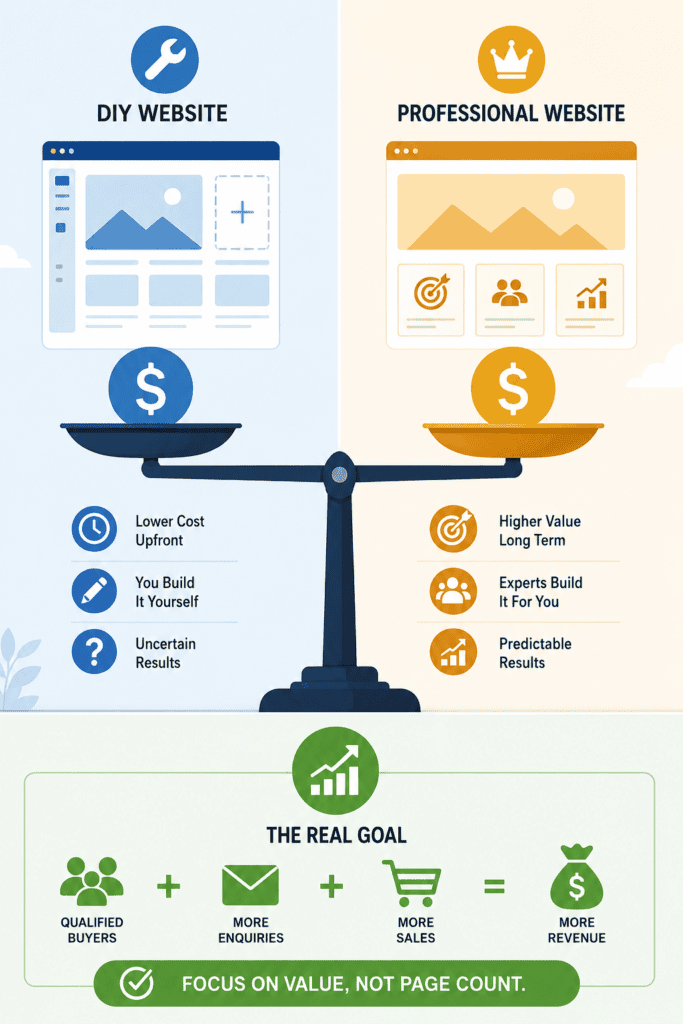
Is It Cheaper to Build a Website Yourself?
If your budget is genuinely zero, then building it yourself is a good place to start.
A basic website is better than no website.
However, if your goal is to generate predictable enquiries and long-term revenue, then you should ask a different question.
Can your DIY website:
- Find buyer-intent keywords?
- Answer buyer questions?
- Rank on Google?
- Generate qualified enquiries?
- Increase sales?
If the answer is yes, then build it yourself.
If not, consider hiring someone who has already proven they can.
Why Business Results Matter More Than Page Count
I’ve seen businesses spend less money on websites that never generated a single customer.
I’ve also seen a single well-planned page generate millions of naira in sales.
That’s why I no longer measure websites by:
- Number of pages.
- Fancy animations.
- Modern appearance.
I measure them by:
- Buyer traffic.
- Enquiries.
- Sales.
- Revenue.
- Return on investment.
That’s what business owners should be buying.
Why Businesses Choose IZIKEEZY DIGITAL
At IZIKEEZY DIGITAL, we don’t begin by asking how many pages you want. We Are Website Designers in Ikeja, Lagos, Nigeria for Businesses That Want Customers, Not Just a Fine Website.
We begin by understanding your business.
Our goal is to help businesses:
- Discover what buyers are already searching for.
- Build pages around those searches.
- Position the website in front of qualified buyers.
- Generate consistent enquiries.
- Reduce dependence on paid advertising.
- Create measurable business growth over time.
Because a website should become one of your best-performing business assets.
Frequently Asked Questions
How much does it cost to design a website per page?
There is no meaningful fixed price. The investment depends on the purpose of the page, the business goals, the research involved, and the value the page is expected to generate.
How much should I pay to design a website?
Instead of focusing only on price, ask what business results the website is expected to produce. A website that generates qualified buyers and sales usually provides much greater long-term value than a cheaper website that produces nothing.
How much do website designers charge in Nigeria?
Website pricing in Nigeria varies widely depending on experience, project complexity, and business objectives. Avoid comparing projects only by page count because no two businesses have the same goals.
How much does a 10-page website cost?
There is no standard cost. Ten pages built without strategy may be less valuable than a single page built around buyer-intent searches.
Is it cheaper to build a website yourself?
Yes, if your budget is genuinely zero. However, consider the opportunity cost if the website fails to generate enquiries, customers, or revenue.
Can ChatGPT create a website?
AI tools can help generate code, ideas, and content, but they still need someone who understands the business, the buyer, and the strategy needed to produce measurable results.
Why choose IZIKEEZY DIGITAL?
IZIKEEZY DIGITAL builds websites that focus on answering buyer-intent questions, attracting qualified buyers organically, improving Google visibility, generating enquiries, and helping businesses achieve measurable return on investment.
Key Takeaways
- Stop asking “How much does it cost to design a website per page?” Start asking “How much business value will this page generate?”
- One buyer-focused page can outperform an entire website built without strategy.
- Website pricing should reflect business outcomes, not simply the number of pages.
- Measure a website by its buyer traffic, enquiries, sales, revenue, and ROI—not by how many pages it contains.
- Hire the professional who can demonstrate they know how to build pages that consistently produce measurable business results.