TL;DR: The Cost Of Building A Website For A Small Business In Nigeria is determined less by the number of pages and more by the business value the website is expected to create. A website that consistently attracts buyers and generates revenue is worth far more than a cheaper website that simply exists online.
Spoiler: The cheapest website often becomes the most expensive business decision.
Summary: If you’re searching for the Cost Of Building A Website For A Small Business In Nigeria, the answer is simple: there is no single price because every business has different goals, customers, and challenges. Instead of asking, “How much does a website cost?”, ask, “What business problem will this website solve, and what return will it generate?” That question leads to a much better investment and usually a much better website.
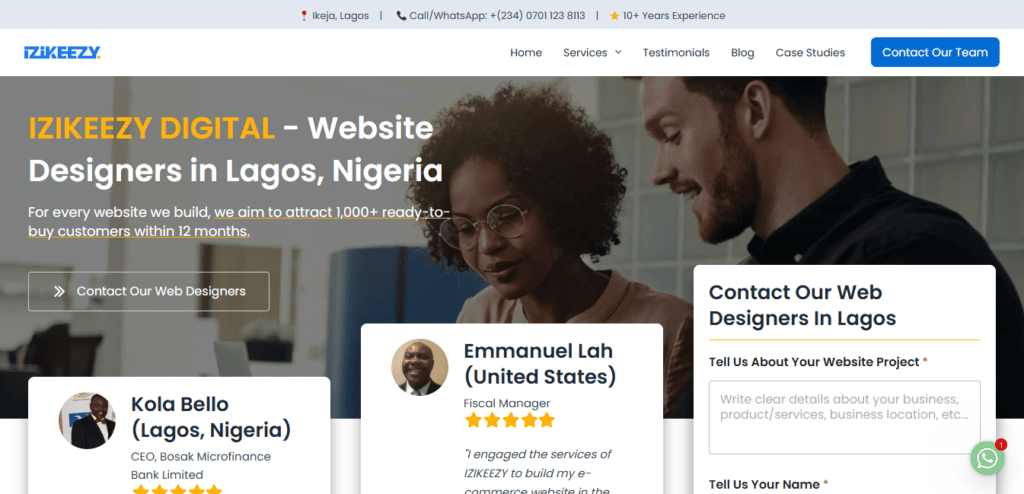
We Are Website Designers in Ikeja, Lagos, Nigeria. For every website we build, we aim to attract 1,000+ ready-to-buy customers within 12 months.
Introduction
One of the first questions almost every business owner asks is:
“How much will it cost to build my website?”
It’s a fair question.
Whether you’re launching a new business or expanding an existing one, every investment has to make financial sense. You don’t want to overspend, and you certainly don’t want to waste money.
But after working with business owners across different industries, I’ve realised something.
Most people are asking the wrong question.
The real question isn’t:
“What is the Cost Of Building A Website For A Small Business In Nigeria?”
The real question is:
“What kind of website am I paying for, and what value will it create for my business?”
Those are two very different conversations.
One focuses on cost.
The other focuses on return.
Unfortunately, many websites are still bought the same way people buy office furniture.
They compare quotations.
They compare page counts.
They compare colours.
They compare how many revisions are included.
Then they choose the cheapest option.
Months later, nothing changes.
The website is online.
But no new customers arrive.
No enquiries come in.
The business owner is still depending on referrals, hoping someone recommends them to the next customer.
I’ve seen this happen many times.
The business didn’t lose money because they paid for a website.
They lost money because the website never helped the business grow.
That is why I believe pricing should never be the first conversation.
Understanding the business should.
Imagine taking your car to a mechanic and asking:
“How much will it cost to repair my car?”
A good mechanic won’t immediately give you a price.
Instead, they’ll probably ask:
- What seems to be the problem?
- When did it start?
- What have you noticed?
- Has anyone worked on it before?
Only after understanding the problem can they estimate the cost of fixing it.
Professional website projects should work exactly the same way.
Before discussing the website creation cost in Nigeria, a web designer should first understand:
- What products or services do you offer?
- What business problem do you want your website to solve?
- What have you already tried?
- If this problem disappeared today, what impact would it have on your business?
- What would happen if nothing changed over the next six months?
Those answers determine the project.
Not the number of pages.
Not the colour scheme.
Not whether you want animations.
When my team begins a project, our first responsibility isn’t designing anything.
It’s understanding the business.
We want to understand where opportunities are currently being lost.
We want to understand how customers are currently finding the business.
We want to understand what buyers are already searching for online.
Only then can we decide what kind of website should be built.
Because sometimes the answer isn’t a twenty-page corporate website.
Sometimes it’s one strategically planned page that answers exactly what buyers are looking for.
I’ve seen a single page outperform entire websites simply because it focused on the right audience with the right information.
That’s why this guide isn’t another article listing average prices.
There are already hundreds of those.
Instead, I’m going to show you what actually determines the Cost Of Building A Website For A Small Business In Nigeria, why some websites cost more than others, why cheaper isn’t always cheaper, and how to make sure your investment continues generating value long after your website goes live.
By the end of this guide, you’ll know what really influences website design cost in Nigeria, what separates a website that simply looks attractive from one that consistently brings in customers, and the questions every business owner should ask before accepting any quotation.

Cost of Creating a Website in Nigeria: What Really Determines the Price?
If you ask ten web designers for a quotation, don’t be surprised if you receive ten different prices.
Some may charge ₦150,000.
Others may charge ₦500,000.
Some may quote over ₦2 million.
Does that mean one designer is overpriced and another is too cheap?
Not necessarily.
The difference is often what each designer believes they’re being hired to do.
Some believe they’re simply building a website.
Others believe they’re helping solve a business problem.
That difference alone can completely change the investment required.
When someone contacts our team asking about the cost of creating a website in Nigeria, we don’t immediately send a price list.
Instead, we start asking questions.
- What products or services does your business offer?
- What challenge are you trying to solve?
- How are customers currently finding you?
- What have you already tried?
- If your website started bringing qualified enquiries every week, how would that change your business over the next twelve months?
Those answers tell us far more than the number of pages ever could.
A website isn’t simply a collection of pages.
It’s a business tool.
Like any business tool, it should solve a specific problem and produce measurable results.
That is why no professional should confidently price your website before understanding your business.
Cost of Building a Website in Nigeria: You’re Paying for Thinking, Not Just Building
Many business owners assume they’re paying for design.
In reality, good website projects begin long before anyone writes a line of code or chooses colours.
You’re paying for research.
You’re paying for planning.
You’re paying for experience.
You’re paying for decisions that help your business grow.
Think about building a house.
The bricks may be visible.
The foundation isn’t.
Yet the foundation determines whether the building survives.
Websites work exactly the same way.
Visitors only see the design.
They never see the hours spent understanding the market, researching competitors, analysing buyer behaviour, planning page structure, identifying search opportunities, and deciding what each page should accomplish.
That invisible work is often what separates a website that generates customers from one that simply looks attractive.
This is why the cost of building a website in Nigeria varies so widely.
You’re not buying pages.
You’re investing in the thinking behind those pages.
Website Creation Cost in Nigeria Should Reflect Business Value
One question I often hear is:
“How many pages will my website have?”
It’s an understandable question.
But it usually leads people in the wrong direction.
I’ve seen businesses with thirty-page websites that generated almost no enquiries.
I’ve also seen one carefully planned page generate millions of naira in sales.
The number of pages has very little to do with business success.
The important question is:
What will each page accomplish?
Will it answer buyer questions?
Will it build trust?
Will it help someone make a buying decision?
Will it encourage qualified enquiries?
If the answer is yes, then that page has value.
That’s why the website creation cost in Nigeria should always be linked to business outcomes rather than page count.
Website Design Cost in Nigeria Isn’t About Colours
Many people think website design begins with choosing colours, fonts and layouts.
Those things matter.
But they aren’t what make businesses successful online.
A beautiful website that nobody visits cannot grow your business.
An average-looking website that consistently attracts qualified buyers often becomes one of the company’s most valuable assets.
When we begin designing, our focus isn’t asking,
“Which colour should the buttons be?”
Instead we ask,
“What questions are buyers asking before they choose this business?”
Because every one of those questions represents an opportunity.
Every question answered builds trust.
Every question answered creates visibility on Google.
Every question answered gives buyers another reason to contact your business instead of your competitors.
That’s why our design process always starts with understanding people before designing pages.
The visual design supports the strategy.
It never replaces it.
Website Development Cost in Nigeria Includes More Than Development
Development is only one part of a successful website.
A developer can build exactly what they’re instructed to build.
But who decides what should be built in the first place?
That’s where strategy becomes valuable.
Before development begins, we usually spend time understanding:
- who the ideal customers are,
- what they search for,
- which services generate the highest value,
- which pages deserve the most attention,
- and what action visitors should take on every page.
Without those decisions, development becomes little more than assembling webpages.
With those decisions, development becomes a business investment.
That is why the website development cost in Nigeria shouldn’t be judged solely by technical ability.
Technical skill is important.
Business understanding is even more valuable.
How Much Does It Cost to Build a Website in Nigeria?
The honest answer is:
It depends on what your business needs the website to accomplish.
If all you need is an online brochure with your phone number, services and contact details, your investment will naturally be different from a business that wants to attract qualified buyers every day from Google.
The purpose of the website determines the work involved.
That is why asking,
“How much does it cost to build a website in Nigeria?”
without discussing your business is a bit like asking,
“How much does it cost to renovate a house?”
Nobody can answer accurately until they know the condition of the house and what you’re trying to achieve.
Professional website projects work exactly the same way.
Our Discovery Process: The Most Important Part of Every Website Project
If there’s one question I believe every business owner should ask before hiring any web designer, it’s this:
“What does your discovery process look like?”
The answer tells you almost everything.
Our discovery process doesn’t begin with templates.
It begins with your business.
We work to understand:
- What products or services you offer.
- The biggest challenge facing your business today.
- What success would look like if your website solved that challenge.
- How customers currently find you.
- What your competitors are doing well.
- Which buyer-intent keywords people search before choosing a business like yours.
- How those searches can become pages that attract qualified buyers.
Only after completing this work do we begin planning the website.
That approach has helped us build websites that don’t simply launch successfully.
They continue producing value long after launch because they were built around real business opportunities rather than assumptions.
For us, that’s what determines the true website cost in Nigeria.
Not the number of pages.
The number of business opportunities the website is capable of creating.
One Sales Page Generated Over ₦3 Million: Why the Cost of a Website Isn’t the Real Question
One of the most valuable lessons I learned didn’t come from reading a book.
It came from a client conversation back in 2018.
A businessman approached my team because he wanted to start selling corporate men’s clothing online. It was his first attempt at selling through a website, so naturally he had many questions. Like most business owners, the first thing he wanted to know was the cost.
After understanding his business, I realised he didn’t need a large website.
He needed one page.
Not just any page, but a page built around the exact questions his potential buyers were already searching for on Google. Instead of creating a homepage full of company history and generic marketing language, we focused on answering buyer-intent questions, removing uncertainty, and making it easy for visitors to take the next step.
Our fee was ₦200,000.
At the time, many web designers were charging around ₦50,000 for something that looked similar.
He told me our price was expensive.
I understood why he felt that way.
If you’re comparing pages, ₦200,000 looks expensive.
If you’re comparing business outcomes, the conversation changes completely.
I explained that he wasn’t paying for a webpage.
He was investing in a digital sales representative that would continue working long after we completed the project.
He eventually agreed, although he remained sceptical. My team reassured him that if we focused on the right buyer searches, the investment had the potential to produce a strong return.
Two months after launching the page, he called with exciting news.
His phone had started ringing throughout the day.
The page had begun appearing for multiple buyer search terms.
More importantly, those visitors were becoming customers.
Within a short period, he had sold more than ₦3 million worth of products from that single page.
That’s approximately a 1,400% return on his investment.
Whenever someone asks me about the Cost Of Building A Website For A Small Business In Nigeria, I often remember that project.
Not because of the design.
But because it proved something important.
A single page built with the right strategy can outperform an entire website built without one.
Why One Good Page Can Be Worth More Than Twenty Average Pages
Many quotations are based on page count.
Five pages.
Ten pages.
Twenty pages.
The assumption is that more pages automatically create more value.
In reality, I’ve rarely found that to be true.
A page only has value if it helps move the business forward.
Does it answer an important question buyers are asking?
Does it build confidence?
Does it remove objections?
Does it encourage enquiries?
Does it bring qualified visitors from Google?
If the answer is no, adding more pages usually increases the size of the website without increasing the value of the business.
That’s why I believe pricing websites solely by page count often misses what matters most.
One page that consistently attracts buyers can easily produce more business than twenty pages nobody ever finds.
When clients ask me how many pages they need, I usually reply with another question:
“How many opportunities do we need to create for your business?”
That conversation almost always leads to a better website.
The Bosak Microfinance Bank Story: Building a Website That Continued Producing Value
Another project reinforced this lesson even further.
A microfinance bank approached us with an outdated website that contributed very little to the business.
Like many organisations, they depended heavily on referrals.
Referrals are valuable.
But they also have limitations.
You don’t control when people refer you.
You don’t control how many referrals arrive next month.
And you certainly don’t control what happens if referrals suddenly slow down.
The bank wanted more certainty.
After understanding their goals, we rebuilt the website, improved its structure, optimised important pages, and positioned the business around searches potential customers were already making.
Within the first 90 days, something interesting happened.
Their website appeared more than 16,000 times in Google Search.
Those impressions translated into qualified buyer traffic without the bank paying for every visitor through advertising.
The estimated value of that traffic exceeded ₦2 million.
Over twelve months, that value grew to approximately ₦24 million worth of organic buyer traffic.
The website didn’t simply launch successfully.
It continued producing value month after month.
That’s exactly what every business owner should expect from a professional website.
Referral Marketing Is Good. Predictable Buyer Traffic Is Better.
Many Nigerian businesses grow almost entirely through referrals.
There’s nothing wrong with that.
In fact, referrals are often a sign that customers appreciate your work.
The challenge is that referrals are difficult to control.
You cannot decide how many people will recommend you next week.
You cannot increase referrals simply because you need more sales this month.
A strategically built website changes that.
Instead of waiting for someone else to recommend your business, your website positions you directly in front of people who are already searching for what you offer.
Every new page targeting buyer-intent keywords becomes another opportunity to reach qualified prospects.
Every useful answer builds trust.
Every additional keyword creates another pathway for customers to discover your business.
Over time, these opportunities compound.
Unlike paid advertising, which usually stops the moment you stop paying, useful website content can continue attracting visitors for months or even years.
That’s why I encourage business owners to think beyond launch day.
A website should continue working long after the designer has finished building it.
The Cheapest Website Can Become the Most Expensive Decision
One reason many small businesses struggle online is that they judge websites only by the initial investment.
Saving money feels like the safest decision.
Sometimes it is.
Sometimes it isn’t.
Imagine you save ₦1.5 million by choosing the cheapest quotation.
Now imagine that professionally built website could have generated one additional customer every month.
If the average customer is worth ₦500,000, you’ve recovered your investment after only a few sales.
Everything after that becomes additional value created by the website.
The question is no longer:
“How much did I spend?”
The question becomes:
“How much business did I fail to generate because I focused only on the initial cost?”
I’ve learned that successful business owners rarely look only at price.
They look at return.
That’s why discussions about the Cost Of Building A Website For A Small Business In Nigeria should never end with a quotation.
They should end with a clear understanding of the business value the website is expected to create over the next one, three and even five years.
Affordable Web Design for Small Businesses in Nigeria: Affordable Should Mean Profitable
When business owners search for affordable web design for small businesses in Nigeria, they’re usually trying to avoid overspending.
There’s nothing wrong with that.
Every business should spend wisely.
The problem is that many people confuse cheap with affordable.
They aren’t the same thing.
A ₦100,000 website that never generates a single customer is expensive.
A ₦1,500,000 website that consistently brings in qualified buyers and pays for itself over the next few months is affordable because it continues creating value long after the invoice has been paid.
I’ve seen business owners proudly choose the lowest quotation, only to discover months later that the website wasn’t helping the business grow. They eventually paid another designer to rebuild everything from scratch.
They didn’t save money.
They simply delayed spending it.
That’s why I encourage clients to think beyond today’s invoice.
Instead, think about the next three years.
Ask yourself:
“Will this website still be helping my business grow three years from now?”
If the answer is yes, the investment becomes much easier to justify.
Small Businesses Websites in Nigeria Need More Than an Online Brochure
One thing I’ve noticed over the years is that many small businesses websites in Nigeria all look remarkably similar.
Home.
About Us.
Services.
Gallery.
Contact.
There’s nothing wrong with those pages.
The problem is that they often stop there.
The website tells visitors what the business wants to say instead of answering what potential customers actually want to know.
Every day, thousands of Nigerians search Google before making purchasing decisions.
They ask questions.
They compare alternatives.
They look for recommendations.
They try to reduce uncertainty before spending money.
Unfortunately, many business websites never answer those questions.
As a result, they miss opportunities to build trust before competitors do.
I believe every website should become an educational resource as well as a sales tool.
The businesses that answer the best questions often become the businesses buyers trust the most.
How to Create a Website in Nigeria That Continues Growing Your Business
If someone asked me how to create a website in Nigeria, I’d explain that building the website is actually one of the later steps.
The first step is understanding the business.
Before choosing colours, layouts or features, we need to understand:
- What products or services does the business offer?
- What problem are we trying to solve?
- Who are the ideal customers?
- What are they already searching for?
- Which pages should exist because buyers actually need them?
Once those answers are clear, we move into research.
We study competitors.
We identify buyer-intent keywords.
We organise pages around real customer questions.
Only after completing that work do we begin designing.
Once the website is launched, the work isn’t finished.
We connect the website to Google Search Console, monitor performance, publish additional pages targeting new buyer searches, and continue improving visibility over time.
That ongoing process is often what separates an average website from one that continues generating enquiries year after year.
Cost to Create Website Nigeria 2026: What Will Actually Change?
Many people are already searching for cost to create website Nigeria 2026 and cost of building a website in Nigeria 2026.
Prices will certainly change.
Software will improve.
AI tools will become more capable.
Design trends will continue evolving.
But I don’t believe the most important factor will change.
Businesses will still need customers.
Customers will still search for answers before making buying decisions.
Businesses that consistently provide those answers will continue attracting attention.
Technology may change.
Human behaviour changes much more slowly.
That’s why I believe the businesses that invest in visibility, trust and helpful content today will continue benefiting for many years.
Website Building Cost in Nigeria Is Only One Part of the Investment
When people think about website building cost in Nigeria, they usually focus on what they’ll spend today.
I encourage clients to think about something else.
What will the website earn tomorrow?
Imagine two business owners.
The first spends less on a website that never generates a customer.
The second invests more in a website that consistently attracts qualified buyers every month.
Five years later, which investment turned out to be cheaper?
The answer becomes obvious.
A website should never be judged only by what it costs.
It should also be judged by what it returns.
That’s why I often describe websites as business assets rather than business expenses.
The right website keeps working long after launch.
How Much Is Web Design in Nigeria?
One of the most common questions online is:
“How much is web design in Nigeria?”
The honest answer is that there isn’t a fixed price.
The investment depends on what your business needs.
A simple informational website requires a different level of planning from a website designed to generate qualified enquiries every week.
Likewise, a small local business has different objectives from a national brand or an e-commerce company.
Rather than looking for the cheapest quotation, look for the designer who asks the best questions.
Ask them about their discovery process.
Ask how they’ll help your business become visible on Google.
Ask how they’ll measure success.
Ask to see examples of websites they’ve built that generated measurable business results.
Without revealing confidential client information, they should be able to show case studies, analytics screenshots, keyword rankings or testimonials demonstrating that their work has produced real outcomes.
Those conversations will tell you far more than comparing quotations.
Cost of a Business Website: The Best Investment Is One That Keeps Paying You Back
Every business owner wants certainty.
Nobody enjoys wondering where the next customer will come from.
That’s one of the reasons I enjoy building websites.
A well-planned website can reduce that uncertainty.
When your business appears in front of people who are already searching for what you sell, you’re no longer relying entirely on referrals or paid advertising.
Instead, you’re building an asset that continues creating opportunities.
That doesn’t happen overnight.
It requires planning.
Research.
Consistency.
And a clear understanding of what your buyers need before they contact you.
That’s why I believe the cost of a business website should never be measured only by today’s invoice.
It should be measured by the opportunities it creates, the customers it attracts, and the freedom, certainty and time that successful business growth can provide.
Conclusion: The Right Website Costs Less Than the Wrong One
If you’ve read this far, you’ve probably realised that there isn’t one fixed Cost Of Building A Website For A Small Business In Nigeria.
And that’s exactly how it should be.
Every business is different.
Every customer is different.
Every market is different.
A website built for a local restaurant won’t require the same strategy as one built for a microfinance bank, a manufacturing company, a treatment centre, or an engineering firm.
That’s why professional web designers begin by understanding the business before discussing price.
In my experience, the businesses that achieve the best results aren’t necessarily the ones that spend the most.
They’re the ones that invest in solving the right problem.
Over the years, I’ve watched businesses spend very little on websites that never generated a single enquiry.
I’ve also watched one strategically planned page produce millions of naira in sales because it answered exactly what buyers were searching for.
That experience changed how I think about website pricing.
I no longer ask,
“How much does the website cost?”
Instead, I ask,
“How much value can this website create over the next five years?”
That single question usually leads to much better decisions.
If your website becomes visible when buyers are searching, consistently earns trust before competitors do, and continues generating enquiries month after month, then it stops being another business expense.
It becomes one of your most valuable business assets.
Frequently Asked Questions
What is the average Cost Of Building A Website For A Small Business In Nigeria?
There isn’t a fixed average because every business has different goals, requirements, and opportunities. The right investment depends on what the website needs to achieve.
How much does it cost to build a website in Nigeria?
The cost depends on the type of website, the level of research required, the functionality needed, and whether the goal is simply to create an online presence or to generate qualified buyers and measurable business results.
Why do website prices vary so much?
Professional web designers don’t all provide the same service. Some focus mainly on design, while others include business discovery, market research, buyer keyword research, content planning, SEO, ongoing optimisation, and long-term support.
Is a cheap website always a bad idea?
Not at all. If your budget is genuinely limited, a simple website is better than no website. The important question is whether that website will help your business grow over time.
Should I choose the cheapest quotation?
Not until you understand what’s included. Ask every designer about their discovery process, how they’ll measure success, what business problem the website will solve, and whether they can show evidence of websites they’ve built that generated measurable business results.
Is SEO included in every website?
No. Many websites are technically search-engine friendly, but that isn’t the same as building pages around buyer-intent searches that attract qualified traffic. Ask exactly what optimisation is included.
What should I expect after my website goes live?
Launch is only the beginning. A good website should be monitored, updated, improved, and expanded over time as new opportunities are identified.
Does every business need a large website?
No. Sometimes one strategically planned page can outperform a twenty-page website if it answers the right buyer questions and encourages visitors to take action.
Do you recommend DIY website builders?
Yes, if your budget is genuinely zero. They’re a good starting point. As your business grows, investing in professional strategy usually delivers a much stronger long-term return.
How do I know whether my current website is working?
Ask simple questions. Is it attracting qualified visitors? Is it generating enquiries? Is it increasing sales? If six months have passed with little or no measurable impact, it may be time to review your strategy.
Why choose IZIKEEZY DIGITAL?
IZIKEEZY DIGITAL builds websites with one goal in mind: helping businesses achieve measurable business results. Every project begins with understanding your business, researching buyer-intent opportunities, and building pages that help your business become visible to people who are already searching for what you offer.
What makes IZIKEEZY DIGITAL different?
Rather than beginning with templates or page counts, we begin by understanding your business. We research buyer-intent keywords, structure websites around real customer questions, optimise for Google visibility, and continue improving performance after launch. Our goal isn’t simply to deliver a beautiful website—it’s to help you build a website that continues producing value.
Does IZIKEEZY DIGITAL provide maintenance?
Yes. Every recommendation includes clearly defined support, updates, and maintenance. The duration depends on the agreed project scope and is documented in our Service Level Agreement (SLA).
Does IZIKEEZY DIGITAL provide an SLA?
Yes. We provide a Service Level Agreement outlining deliverables, responsibilities, support, maintenance, timelines, and everything included in your investment so expectations are clear from the beginning.
Key Takeaways
- The Cost Of Building A Website For A Small Business In Nigeria should be judged by business value, not page count.
- A strategically built website can continue attracting qualified buyers and generating enquiries long after launch.
- Always choose the web designer who asks the best questions before giving you a quotation.
- The cheapest website is often the one that costs your business the most in missed opportunities.
- Invest in a website that solves a real business problem, produces measurable results, and gives your business more freedom, certainty, and time.
One Final Thought
When someone asks me, “What does a website cost?”, I usually smile.
Because after years of building websites for businesses, I’ve learned that cost is only part of the conversation.
The better question is:
“What kind of business could this website help me build?”
That question has never led me—or my clients—to the wrong investment.