TL;DR: How Much Is Website Design In Nigeria? The honest answer is that it depends on the business problem the website is expected to solve and the value it can create. A website that consistently attracts buyers and generates sales is worth far more than one that simply looks beautiful.
Spoiler: Don’t buy the cheapest website. Buy the website most likely to grow your business.
Summary: If you’re searching “How Much Is Website Design In Nigeria”, you’re asking a sensible question, but probably not the most important one. The better question is: “How much business value will this website create?” The right website should attract qualified buyers, generate enquiries, increase revenue, and continue producing results long after it has been launched.
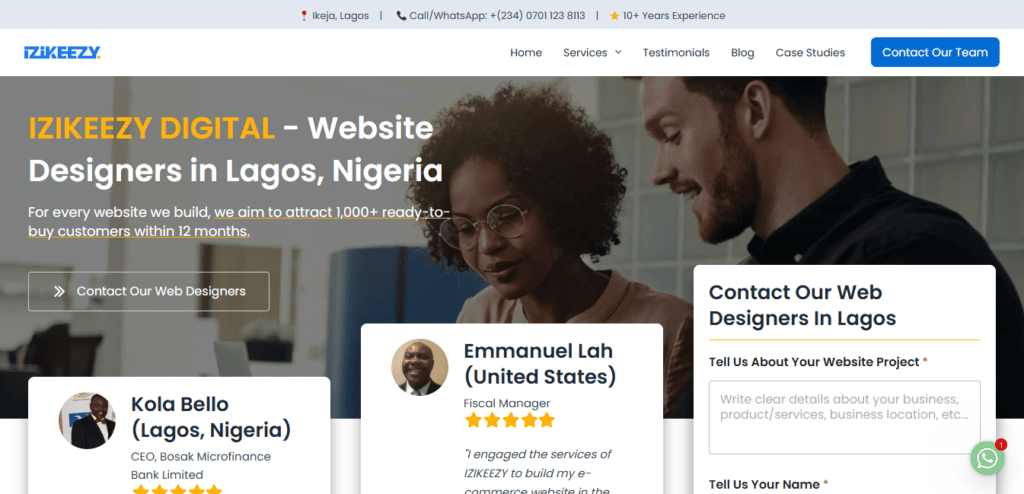
We Are Website Designers in Ikeja, Lagos, Nigeria. For every website we build, we aim to attract 1,000+ ready-to-buy customers within 12 months.
Introduction
How Much Is Website Design In Nigeria? In my experience, there isn’t one fixed answer because no two businesses have the same goals, customers, or challenges. The cost of a website should be determined by the business value it is expected to create, not simply by the number of pages or how attractive it looks.
I’ve been designing websites for years, and one thing I’ve noticed is that many business owners start the conversation with price.
“How much will my website cost?”
It’s a fair question.
Every business has a budget.
But after working with businesses in different industries, I’ve realised something.
The businesses that achieve the best return on investment rarely begin by talking about price.
They begin by talking about problems.
They ask questions like:
- How can we generate more enquiries?
- How can we reduce dependence on referrals?
- How can more buyers find us on Google?
- How can our website generate sales every month?
- How can this investment pay for itself?
Those questions lead to better websites.
More importantly, they lead to better businesses.
How Much Is Website Design In Nigeria?
Let’s answer the question directly.
How Much Is Website Design In Nigeria?
There is no single price.
The cost depends on what your website is expected to achieve.
Think about it this way.
If you took your car to a mechanic and asked,
“How much will it cost to repair my car?”
No honest mechanic would give you an exact price immediately.
The first question would be,
“What’s wrong with the car?”
Until they inspect it, every figure is simply a guess.
Website projects work exactly the same way.
Before discussing price, a professional web designer should understand:
- What products or services you offer.
- What business challenges you’re facing.
- What role the website should play.
- What success looks like for your business.
- What results you expect over the next 12 months.
Without that understanding, quoting a price is little more than guessing.
That is why I don’t believe businesses should choose a web designer based only on who offers the lowest quotation.
Instead, choose the professional who understands your business well enough to recommend the right solution.
How Much Does Website Design Cost?
When people ask “How much does website design cost?”, they’re usually expecting a price list.
The reality is more complicated.
A website isn’t a product sitting on a supermarket shelf with one fixed price.
It’s a business tool.
Just as businesses have different goals, websites have different jobs to do.
For example, a simple one-page website introducing a local consultant is very different from an online store selling hundreds of products across Nigeria.
A microfinance bank needs something different from a construction company.
A treatment centre has different priorities from a law firm.
Even two businesses in the same industry can require completely different websites because they’re trying to solve different problems.
That’s why the cost of website design varies.
The real question isn’t:
“How much does a website cost?”
The better question is:
“What business problem will this website solve, and what value will solving that problem create?”
That single question changes how you evaluate every proposal you receive.
Cost of Creating a Website in Nigeria
The cost of creating a website in Nigeria is influenced by far more than colours, layouts, and page numbers.
A professionally built website usually includes work that many business owners never see.
Before the first page is designed, there should already be a clear understanding of the business, its customers, and its goals.
For every project my team handles, we begin with discovery.
We ask questions such as:
- What products or services do you offer?
- What business problem should the website solve?
- What have you already tried?
- What would change if we solved this problem today?
- Who are your ideal customers?
- What questions are they asking before they decide to buy?
- How do you want your business to be known?
Those conversations shape every decision that follows.
Next comes research.
We study the market, analyse competitors, identify buyer-intent keywords, and look for opportunities where the business can become visible when potential customers are searching online.
Only then do we begin planning the website.
That’s why two websites with the same number of pages can have completely different prices.
One is simply built.
The other is strategically planned to produce measurable business results.
Why Most Business Owners Ask the Wrong Question
One of the biggest misconceptions about website pricing is believing that the number of pages determines the value of the project.
In reality, one well-planned page can outperform an entire website.
Several years ago, a client approached me because he wanted to sell corporate men’s clothing online.
It was his first experience selling online, so we spent time discussing how people actually search before making a purchase.
Instead of creating dozens of pages, we built a single sales page focused on answering the questions his buyers were already searching for on Google.
At the time, we charged ₦200,000 for the project.
Many other designers were charging around ₦50,000, so he initially felt our price was too high.
I explained that he wasn’t paying for another webpage.
He was investing in something designed to bring buyers to his business every day.
Two months after launch, that single page ranked for multiple buyer searches.
His phone rang constantly.
He later told me the page had helped him generate more than ₦3 million in sales.
That’s roughly a 1,400% return on investment from one page.
That experience reinforced something I still believe today.
The cost of a website isn’t measured by how many pages it contains.
It’s measured by the business value those pages create.
Cost of Website Design in Nigeria
The cost of website design in Nigeria varies because every business has different objectives. A restaurant trying to attract local diners has different needs from a hospital looking to educate patients, and both are different from an online store selling products nationwide.
This is why I don’t believe professional web designers should start by asking, “How many pages do you want?” That question comes too early.
The first questions should be:
- What products or services do you offer?
- What business problem should your website solve?
- What have you tried in the past?
- What would change if this website solved that problem?
- How do you want customers to find your business?
Those answers determine the scope of the project far better than the number of pages ever will.
For example, two businesses may both request a five-page website. One simply needs an online presence, while the other wants to rank on Google, attract qualified buyers, generate enquiries, and reduce dependence on paid advertising. Although the number of pages is the same, the amount of strategy, research, content planning, and optimisation required is completely different.
That is why the cost of website design in Nigeria should always reflect the work involved in achieving business goals, not just building web pages.

Web Design Price List in Nigeria
Many people search for a web design price list in Nigeria because they want a quick estimate before contacting an agency.
There is nothing wrong with wanting an idea of the investment involved. However, a price list should only be treated as a guide, not a final quotation.
Professional website projects are usually influenced by factors such as:
- The type of business.
- The complexity of the website.
- The amount of market and keyword research required.
- Whether content needs to be written or rewritten.
- The number of buyer-intent pages that need to be created.
- Special features such as online payments, booking systems, or customer portals.
- Ongoing maintenance and technical support.
This is similar to building a house. Two houses may have the same number of rooms, yet one costs significantly more because of the quality of materials, the location, and the level of craftsmanship involved.
Websites work the same way.
A useful price list helps you prepare a budget, but it should never replace a proper discovery session where the designer first understands your business.
Website Design Cost in Nigeria
When business owners ask about website design cost in Nigeria, they often expect a fixed figure.
In my experience, that expectation usually leads to disappointment because it encourages comparing prices instead of comparing value.
Imagine receiving two proposals.
The first designer charges much less but simply promises a beautiful website.
The second designer charges more but explains how they will research your market, identify buyer-intent keywords, build pages around those searches, optimise your website for Google, monitor performance after launch, and continue improving it over time.
Both proposals are for a website.
But they are not offering the same service.
The first is selling pages.
The second is helping build a system that can continue bringing new customers to your business.
That difference is why price alone should never determine your decision.
Website Design Price in Nigeria
The website design price in Nigeria should never be judged only by what leaves your account today.
It should be judged by what returns to your business over the months and years that follow.
Several years ago, one client questioned why our fee was significantly higher than what other designers were charging.
At first glance, I understood his concern.
If two websites appear similar, why pay more?
The answer became clear after launch.
Instead of simply existing online, his website became visible when buyers searched for the products he sold. Those visitors became enquiries, those enquiries became customers, and those customers generated millions of naira in sales.
The website stopped being an expense.
It became an investment.
That experience changed the way many of my clients think about pricing.
Rather than asking, “How much does this website cost?”, they begin asking, “How much business can this website help me generate?”
That’s a far better question.
How Much Do Web Designers Charge in Nigeria?
There is no standard answer to how much do web designers charge in Nigeria because designers offer very different levels of service.
Some focus mainly on visual design.
Others focus on development.
Some specialise in e-commerce.
Others work with corporate organisations.
Then there are agencies that combine strategy, research, content, optimisation, maintenance, and long-term growth into one service.
Those differences naturally affect pricing.
Whenever you’re comparing quotations, don’t simply compare numbers.
Compare what is actually included.
Ask questions like:
- What does your discovery process involve?
- Will you research my market?
- Will you identify buyer-intent keywords?
- Will the pages be written around what customers are already searching for?
- What happens after the website goes live?
- Do you provide maintenance?
- Is support included?
- Do you have a Service Level Agreement that clearly defines what is covered?
The answers to those questions will usually tell you far more than the quotation itself.
Website Design Prices
When comparing website design prices, remember that the cheapest option is not always the least expensive.
A website that costs very little but never generates customers can become one of the most expensive business decisions you make because of the opportunities it fails to create.
Let’s look at a simple example.
Suppose your average customer is worth ₦500,000 to your business.
If a professionally built website helps you attract just one additional customer every month, that could generate ₦6 million over twelve months.
Now compare that with choosing a cheaper website that never attracts qualified enquiries.
The money you saved upfront may be insignificant compared to the revenue you never earned.
That is why every website should be evaluated by its return on investment, not simply by its purchase price.
Website Designing Charges
Professional website designing charges should reflect much more than the time spent arranging text and images.
A successful website project often includes:
- Business discovery.
- Market research.
- Competitor analysis.
- Buyer keyword research.
- Information architecture.
- Content planning.
- User experience design.
- Website development.
- Testing.
- Google Search Console setup.
- Search engine indexing.
- Ongoing improvements.
- Maintenance and support.
Many of these activities happen before visitors ever see the finished website.
Yet they are often the very things that determine whether the website succeeds or fails.
A beautiful website without strategy may receive compliments.
A strategic website receives customers.
Website Design Cost: What Are You Really Paying For?
When people hear the phrase website design cost, they often imagine paying for colours, layouts, images, and pages.
Those things are visible.
The real value is often invisible.
You’re paying for experience.
You’re paying for better decisions.
You’re paying for someone who has solved similar problems before.
You’re paying for someone who understands how buyers search, what builds trust, what encourages enquiries, and how a website can continue creating value long after launch.
In other words, you’re not simply paying someone to build a website.
You’re investing in a business asset that, when built correctly, can continue attracting qualified buyers, generating enquiries, and producing measurable business results for years to come.
A Website Should Be Measured by the Results It Produces, Not the Price You Paid
When people search “How Much Is Website Design In Nigeria”, they usually expect a price.
I understand why.
Every business owner wants to know how much they need to budget before starting a project.
But after working with businesses over the years, I’ve come to believe that price is only a small part of the decision.
The bigger question is this:
What business result should the website produce?
That one question changes everything.
A website that costs less today but never attracts customers is expensive.
A website that costs more but consistently generates qualified enquiries, sales, and revenue quickly becomes one of the best investments a business can make.
This is why I encourage every client to stop thinking about websites as digital brochures.
Think of them as business assets.
An asset should continue creating value long after you’ve paid for it.
Your website should do exactly the same.
The ₦200,000 Page That Generated More Than ₦3 Million in Sales
One experience completely changed how I think about website pricing.
Back in 2018, a business owner approached me because he wanted to begin selling corporate men’s clothing online.
It was his first experience selling online, so naturally he had many questions. Like many business owners, he assumed the website simply needed attractive pictures, product descriptions, and a contact button.
I suggested something different.
Instead of trying to build a large website immediately, I recommended starting with a single page.
Not just any page.
A page built around the exact questions potential buyers were already asking on Google before making a purchase.
That meant spending time understanding the market, researching buyer behaviour, identifying the right search terms, and structuring the page to answer those questions clearly.
When I quoted ₦200,000, he hesitated.
Many designers were charging around ₦50,000, so from his perspective our proposal seemed expensive.
I explained that he wasn’t paying for another webpage.
He was investing in something designed to keep attracting buyers long after it had been published.
Eventually he agreed.
Two months after launch, that single page began ranking for multiple buyer searches.
His phone rang constantly.
Customers who had never heard of his business were calling because they had found him while searching online.
Later, he told me that page had helped him generate more than ₦3 million in product sales.
That’s roughly a 1,400% return on investment from one strategically built page.
Whenever someone asks me how much website design should cost, I remember that project.
The value wasn’t in the page.
The value was in what the page continued producing.
Why Referral Marketing Eventually Limits Business Growth
Many of the businesses that contact us already receive customers through referrals.
There is absolutely nothing wrong with referrals.
In fact, they are often a sign that you’re doing good work.
The problem is that referrals place a ceiling on growth.
You cannot completely control who refers your business.
You cannot control when they refer.
You cannot control how many people they refer each month.
Your growth depends on someone else’s decision.
A strategically built website changes that.
Instead of waiting for referrals, your business begins appearing in front of people who are already searching for what you sell.
Those people are actively looking for answers.
They are researching.
They are comparing options.
If your website is the one that answers their questions clearly and honestly, you begin building trust before they ever contact you.
That creates something referrals alone rarely provide:
Predictability.
Instead of hoping customers arrive, you build a system designed to attract them continuously.
People Ask Thousands of Questions Every Day. Your Website Should Answer Them.
One of the biggest opportunities most businesses miss is surprisingly simple.
People ask questions every day.
They ask Google.
They ask AI tools.
They ask friends.
They ask social media.
Before choosing a business, customers almost always have questions.
Unfortunately, many business websites answer almost none of them.
Instead, they focus on pages like:
- Home
- About Us
- Our Mission
- Our Vision
- Contact Us
Those pages are useful.
But they rarely answer the questions buyers actually type into Google.
That’s where I believe businesses should think differently.
My team spends time finding the exact questions potential customers are already asking.
Then we create pages that answer those questions clearly.
As more useful pages are published, more buyers discover the business.
Trust begins to grow.
Visibility increases.
More enquiries follow.
The process repeats itself month after month.
This is one reason our clients don’t see their websites as finished after launch.
The website becomes a growing library of helpful answers that continues attracting qualified visitors over time.
We Don’t Want Every Visitor. We Want the Right Visitor.
Traffic alone isn’t success.
Ten thousand visitors who never become customers are less valuable than one hundred qualified visitors who genuinely need your service.
That is why we don’t simply focus on increasing traffic.
We focus on attracting the right people.
Once visitors arrive, we also help businesses qualify them before they make contact.
For many projects, this includes carefully designed enquiry forms that ask relevant questions before someone reaches the business owner.
The result is simple.
Business owners spend less time answering enquiries from people who are not a good fit.
Instead, they spend more time speaking with people who genuinely need their products or services.
That makes the website valuable for both the customer and the business.
The Bosak Microfinance Bank Story
Another project that reinforced my thinking involved a microfinance bank.
Before we became involved, the bank relied almost entirely on referral-based marketing.
Its website was outdated and contributed very little to business growth.
After understanding the organisation, we rebuilt the website with a different objective.
The goal wasn’t simply to modernise its appearance.
The goal was to increase visibility where potential customers were already searching.
Within approximately ninety days, the website began ranking for more than twenty buyer-related keywords.
Google Search recorded over 16,000 impressions, creating an estimated ₦2 million worth of buyer traffic without relying on paid advertising.
Over the course of a year, that value continued to grow, representing more than ₦24 million worth of free buyer traffic.
The Managing Director later shared a testimonial describing the decision to work with our team as one of the best investments the bank had made in improving its online presence.
That project reminded me of something important.
A beautiful website may impress visitors.
A visible website attracts visitors.
The second one usually creates far greater business value.
Why I Rarely Start a Conversation with Price
After these experiences, my first conversation with every client changed.
Instead of asking,
“What type of website do you want?”
I ask questions like:
- What products or services do you offer?
- What business challenge would you like this website to solve?
- What have you already tried?
- What would change if we solved this problem today?
- What type of customer do you want to attract?
- What would success look like twelve months after launch?
Those questions reveal the real project.
Only after understanding the business can anyone responsibly discuss price.
Without that understanding, every quotation is simply a guess.
That is why I believe the answer to “How Much Is Website Design In Nigeria?” begins with understanding the business—not counting pages.
How Much Does It Cost to Design a Website in Nigeria?
If you’ve read this far, you’ve probably realised that answering “How much does it cost to design a website in Nigeria?” with one fixed price would be misleading.
Imagine two business owners.
The first owns a local fashion store and simply wants customers to know the business exists.
The second wants to reduce dependence on Instagram, appear on Google when people search for products, generate enquiries every week, and eventually sell online.
Both need a website.
Neither needs the same website.
Although the finished websites may appear similar on the surface, the amount of thinking, planning, research, and implementation behind them is completely different.
That is why I always encourage business owners to think beyond today’s invoice.
Ask yourself:
“If this website works exactly as intended, what could it be worth to my business over the next three years?”
That question usually changes the conversation from cost to investment.
Website Development Cost in Nigeria
Many people confuse website design with website development.
Design is how the website communicates with people.
Development is how the website functions.
Both are important.
But neither should come before understanding the business.
A website can have excellent programming and still fail to generate enquiries.
Likewise, it can look beautiful and still receive no visitors.
That’s why our process begins long before any design or development starts.
We first understand what success should look like.
Only then do we decide what needs to be designed and developed.
This approach helps us avoid building features our clients don’t need while making sure we invest time in the things that actually move the business forward.
Cost of Building a Website in Nigeria
The cost of building a website in Nigeria is influenced by several factors.
Some are obvious.
Others are invisible.
Visible costs include:
- Design.
- Development.
- Images.
- Hosting.
- Domain registration.
Less visible—but often more valuable—are activities such as:
- Discovery sessions.
- Market research.
- Competitor analysis.
- Buyer keyword research.
- Website planning.
- Content strategy.
- Google Search Console setup.
- Performance monitoring.
- Ongoing optimisation.
- Long-term maintenance.
These are the activities that help transform a website from an online brochure into a business asset.
When comparing quotations, make sure you’re comparing everything that is included—not just the final number.
Different Types of Websites
One reason website prices vary so much is because businesses require different types of websites.
Some of the most common include:
- Corporate websites.
- Small business websites.
- E-commerce websites.
- Landing pages.
- Lead generation websites.
- Personal portfolio websites.
- School websites.
- Hospital and treatment centre websites.
- Real estate websites.
- Financial institution websites.
- Membership websites.
- Booking websites.
Every type of website serves a different purpose.
For example, a corporate website may focus on building credibility, while an e-commerce website focuses on helping people buy products online.
A lead generation website is different again because its primary objective is generating qualified enquiries.
Before discussing price, first identify which type of website best supports your business goals.
Cost of Designing an E-commerce Website in Nigeria
Business owners frequently ask about the cost of designing an e-commerce website in Nigeria.
Again, there isn’t one fixed answer.
An online shop selling ten products is very different from one selling two thousand.
Some stores require payment gateways, inventory management, customer accounts, shipping calculations, discount systems, and integration with accounting software.
Others need only a straightforward catalogue with online payments.
The right solution depends entirely on the business.
Rather than asking how much an e-commerce website costs, ask what the website should help your business achieve.
Should it:
- Increase online sales?
- Reach customers nationwide?
- Reduce manual order processing?
- Build customer trust?
- Generate repeat purchases?
The answers determine the solution.
Affordable Web Designers in Lagos: What Should You Really Look For?
Many business owners search for affordable web designers in Lagos because they want to balance quality with budget.
That’s understandable.
However, affordability should never mean choosing the lowest quotation without asking deeper questions.
Whenever you’re speaking with a web designer or agency, ask questions like:
- What does your discovery process involve?
- How will you understand my business?
- How will you identify buyer-intent keywords?
- Can you show examples of websites that generated measurable business results?
- What happens after launch?
- Is maintenance included?
- Do you provide ongoing support?
- Do you have a Service Level Agreement?
These questions reveal far more than a portfolio ever can.
A portfolio shows what someone built.
These questions reveal how they think.
Cheap Website Design in Nigeria: When Is It Worth It?
There are situations where cheap website design in Nigeria makes perfect sense.
If your budget is genuinely zero or close to it, starting small is often better than doing nothing.
A simple website can help establish an online presence while your business grows.
But don’t stop there.
As your business begins generating revenue, reinvest in improving your website.
The goal isn’t simply to own a website.
The goal is to own one that consistently attracts buyers and generates measurable business results.
A cheaper website can be an excellent first step.
It shouldn’t become the final destination if your ambitions for your business are much bigger.
Website Designer Nigeria: The One Question That Reveals Everything
Over the years, I’ve found one question that tells me almost everything about a web designer.
Ask:
“What does your discovery process look like?”
Then listen carefully.
If the conversation immediately jumps to colours, layouts, fonts, page numbers, or templates, something important may be missing.
A strategic designer usually begins elsewhere.
They want to understand:
- Your business.
- Your customers.
- Your biggest challenge.
- Your goals.
- Your competitors.
- Your opportunities.
- The results you hope to achieve.
Only after understanding those things do they begin discussing design.
In my opinion, this single question can save business owners from making very expensive hiring mistakes.
Why IZIKEEZY DIGITAL Takes a Different Approach
At IZIKEEZY DIGITAL, we don’t believe our job ends when a website goes live.
Launching a website is only the beginning.
Our goal is to help businesses become more visible where qualified buyers are already searching.
That means understanding the business first.
Then researching the market.
Then identifying buyer-intent opportunities.
Then building pages that answer those questions.
Then monitoring performance.
Then continuing to improve.
In other words, we’re not simply trying to help clients own a website.
We’re trying to help them own a business asset that keeps creating opportunities long after launch.
That’s a very different objective, and it changes the way every project is approached.
Frequently Asked Questions About How Much Is Website Design In Nigeria
How much is website design in Nigeria?
There is no single price because every business has different goals and challenges. The investment depends on the type of website, the amount of research required, the features needed, the content to be created, and the business results the website is expected to achieve. Instead of asking only about price, ask how much value the website can create over the next few years.
How much does website design cost?
Website design costs vary according to complexity, strategy, functionality, and long-term objectives. A website built simply to provide an online presence costs less than one designed to attract qualified buyers, generate enquiries, and support business growth.
How much do web designers charge in Nigeria?
Web designers in Nigeria charge different fees because they offer different levels of service. Some focus mainly on design, while others include business discovery, keyword research, content planning, optimisation, maintenance, and ongoing support. Always compare what is included, not just the final price.
What is the cost of creating a website in Nigeria?
The cost of creating a website in Nigeria depends on the scope of the project. Factors such as business goals, content creation, e-commerce functionality, integrations, optimisation, and maintenance all influence the final investment.
What is the website development cost in Nigeria?
Website development cost depends on the functionality required. A simple business website differs greatly from an online marketplace, membership platform, banking portal, or booking system. Development should always support the overall business objective.
Is a cheaper website always a better choice?
Not necessarily. A cheaper website that never attracts buyers or generates enquiries may become far more expensive than a professionally planned website that consistently produces measurable business results.
Can one page really generate customers?
Yes. A strategically built page focused on buyer-intent searches can outperform a much larger website that lacks direction. One of our clients generated more than ₦3 million in sales from a single page built around the questions buyers were already searching for online.
How long does it take before a website starts producing results?
The answer depends on your industry, competition, and marketing strategy. Some businesses begin receiving enquiries shortly after launch, while Google visibility often grows over several weeks or months as more useful pages are indexed and trusted.
Should I build my own website?
If your budget is genuinely ₦0, building your own website is a reasonable place to start. As your business grows, investing in a professionally planned website usually produces much stronger long-term results.
Is SEO included in website design?
Every website we build follows good technical practices such as fast loading, mobile responsiveness, and proper page structure. Beyond that, we also focus on understanding buyer intent, researching keywords, and creating pages designed to help businesses become visible when potential customers are searching.
Frequently Asked Questions About IZIKEEZY DIGITAL
What makes IZIKEEZY DIGITAL different from other web design companies?
We don’t begin with templates or page counts. We begin by understanding your business, identifying the biggest problem your website should solve, researching buyer-intent searches, and building pages designed to generate measurable business results.
Do you only build websites?
No. We help businesses position themselves in front of qualified buyers by combining strategic website planning, buyer-focused content, search visibility, ongoing optimisation, and long-term support.
Do you provide website maintenance?
Yes. We provide ongoing maintenance, updates, monitoring, and support according to the agreed package so your website continues performing well after launch.
Do you have a Service Level Agreement (SLA)?
Yes. Every project includes clear documentation outlining responsibilities, deliverables, support, and maintenance, giving clients confidence about what is included throughout the engagement.
Can I see examples of previous work?
Yes. We can share relevant case studies, testimonials, traffic reports, keyword examples, and performance evidence where appropriate, while always respecting client confidentiality.
What industries do you work with?
We’ve worked with businesses across multiple industries, including financial institutions, engineering companies, healthcare providers, retailers, educational organisations, service businesses, and companies selling products online.
Final Thoughts
Whenever someone asks me,
“How Much Is Website Design In Nigeria?”
I no longer think about numbers.
I think about business outcomes.
Over the years, I’ve seen businesses spend very little on websites that never produced a single enquiry.
I’ve also seen businesses invest more in strategically planned websites that continued generating customers, sales, and revenue long after the project had been completed.
The difference wasn’t the number of pages.
It wasn’t the colours.
It wasn’t the animations.
The difference was purpose.
Every successful website I have been involved in had one thing in common.
It was built to solve a real business problem.
Some reduced dependence on referrals.
Some increased visibility on Google.
Some generated qualified enquiries every week.
Some produced returns that far exceeded the original investment.
That’s why I believe the conversation about website pricing should always begin with one simple question:
“What business result are we trying to achieve?”
Once that answer is clear, everything else—including the investment—begins to make sense.
Key Takeaways
- How Much Is Website Design In Nigeria cannot be answered with one fixed price because every business has different goals and challenges.
- Judge a website by the value it creates through buyer traffic, enquiries, sales, and long-term return on investment—not simply by its upfront cost.
- One strategically built page that answers buyer-intent questions can outperform an entire website built without a clear purpose.
- Always choose a web designer who begins by understanding your business, your customers, and the results you want to achieve before discussing design.
- The best website is not necessarily the cheapest or the most beautiful. It’s the one that consistently helps your business grow.